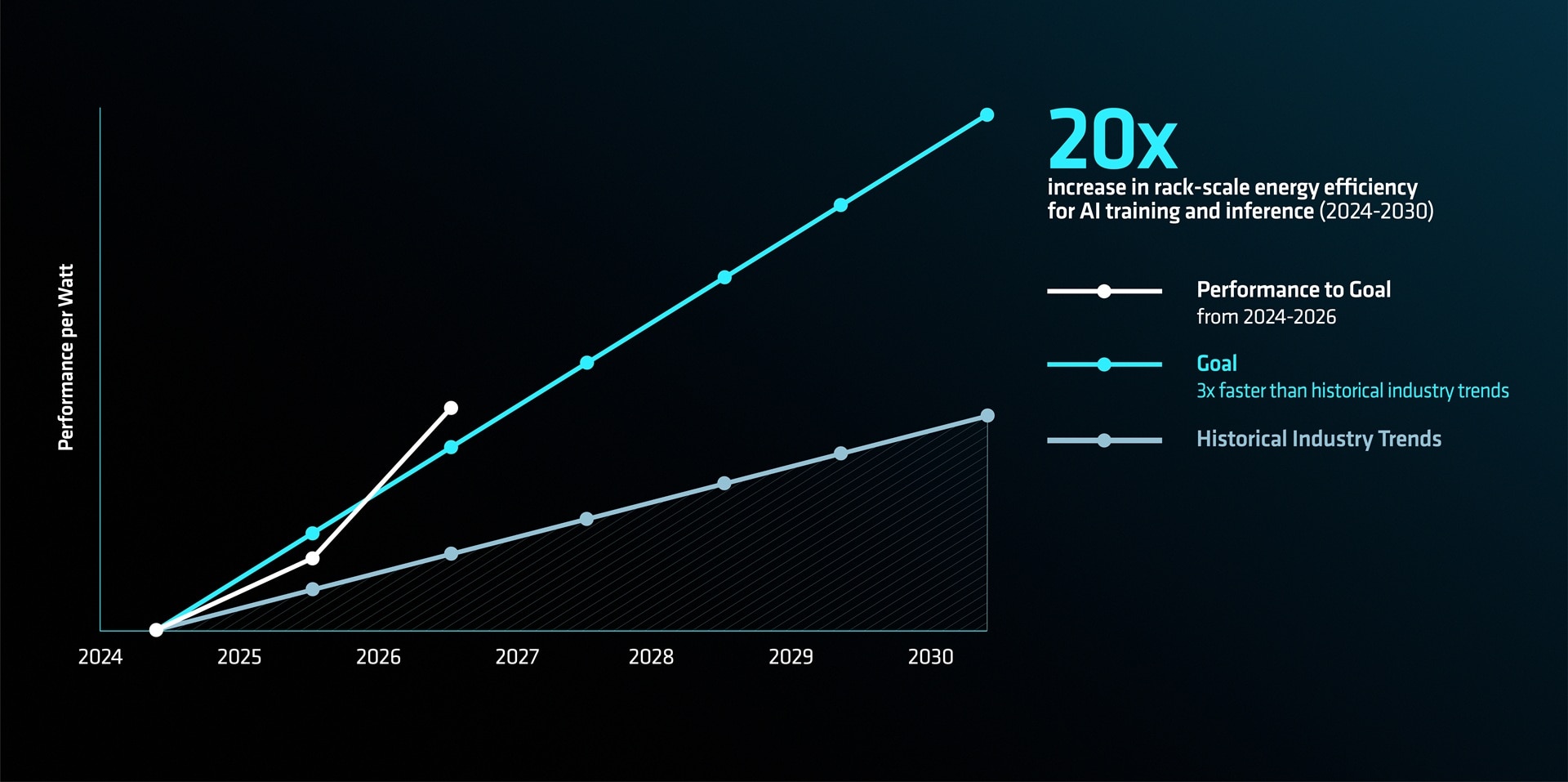
AMD says it has hit a 4x increase in AI energy efficiency since 2024, beating its own 3x target for this stage of a 2030 roadmap that promises a 20x gain overall. The number the company wants people to remember: two AMD racks in 2030 are projected to match the compute output of 570 racks from 2024.
That kind of figure is designed to be repeated, and it's a genuinely useful way to picture the scale of the problem AMD is chasing. AI data centers are growing faster than the power grid feeding them, so squeezing more compute out of the same electricity budget isn't a nice-to-have for AMD's customers, it's what determines whether a data center expansion is financially viable at all.
Worth reading the fine print
AMD's own footnotes are more cautious than the headline. The 4x figure is explicitly described as an estimate, based on "a combination of measured product data and modeled estimates where final performance data was not available," measured against a 2024 baseline AMD defines itself. There's no independent third-party benchmark cited, and the 570-rack comparison rests on a "representative AI training workload" AMD constructed rather than a customer's actual deployment. None of that makes the claim false, but it does mean the number is AMD grading its own progress against AMD's own yardstick.
The technical approach behind the claim is straightforward enough: efficiency gains stacked across compute silicon, memory bandwidth, interconnects, and the ROCm software stack, rather than any single breakthrough component. AMD SVP Sam Naffziger framed it as "tighter co-optimization across compute silicon, memory, interconnects, software and rack-scale system design," which is really just AMD's way of saying no one part of the system gets to slack while another one improves.
For AMD's data center customers, the practical upside is simple: more AI throughput without a proportional jump in power and cooling costs, which matters more than almost any other spec once a deployment reaches rack scale. Whether AMD actually lands the full 20x by 2030 is a separate question this update doesn't answer, it only argues the company is currently on pace.