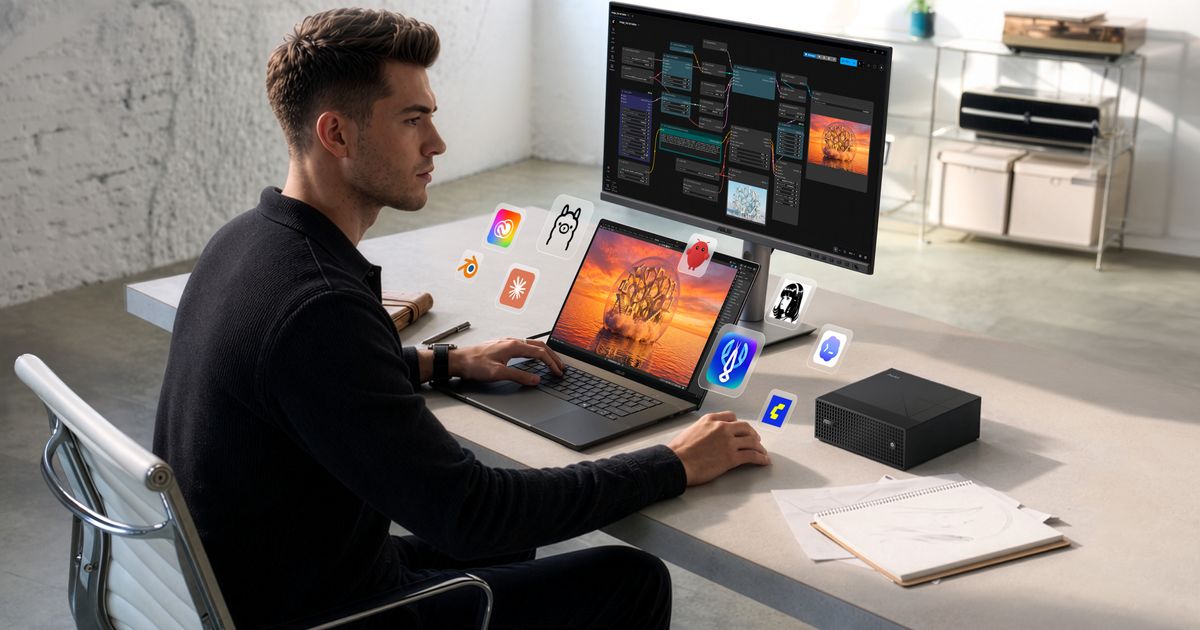
NVIDIA's RTX Spark chip was built for AI developers running local models on desk-side workstations. ASUS just put it inside a 12.9mm laptop and called it a creator notebook. That is either a genuine shrink of enterprise AI hardware into something you can carry in a bag, or a workstation chip wearing a creator laptop's clothes, depending on how much of the pitch actually survives contact with a real workload.
At its IFA 2026 media showroom in Berlin, ASUS unveiled the ProArt P16 and P14 laptops and the ProArt GR1X mini PC, all three powered by RTX Spark. The chip pairs an NVIDIA Blackwell RTX GPU with 6,144 cores to a Grace CPU with up to 20 cores over NVLink-C2C, the same chip-to-chip interconnect NVIDIA uses in its data center hardware. ASUS is marketing the lineup as the first Windows PCs built for personal AI agents, which is a bold claim for hardware that has not shipped a single independent benchmark yet.
The number that matters is memory, not the petaflop figure
ASUS leads with "up to 1 petaflop of AI performance," a figure that sounds impressive until you remember peak AI throughput numbers rarely translate into anything a normal workflow can feel. The more interesting spec is the up to 128GB of unified memory, because memory capacity, not raw compute, is usually what stops a local model from running at all. ASUS says that's enough headroom for a 120-billion-parameter LLM, 90GB-plus 3D scene rendering, and 4K AI video generation, all without touching the cloud.
The pitch for keeping that work local instead of renting it from a cloud AI service is straightforward: no per-token metering, prompts and files staying on the device, and the ability to fine-tune a model instead of working around whatever a hosted API allows. That is a real argument for anyone who has watched a cloud AI bill climb during a busy production month.
Thinner than the workstation branding suggests
Despite the enterprise silicon, ASUS built the P16 and P14 to be its thinnest ProArt laptops yet. The P16 comes in at 12.9mm and 1.77kg, which ASUS says is 14% thinner and 9% lighter than the previous generation, while the P14 drops to 13.9mm and 1.48kg. Both use OLED displays ASUS calls Lumina Pro, rated at Delta E under 1 color accuracy, with the P16 supporting 4K at 120Hz with NVIDIA G-Sync and the P14 topping out at 3K.
The GR1X mini PC squeezes the same RTX Spark chip into a 150 x 150 x 51mm chassis with a 218-blade dual-fan cooling system built for 24/7 operation, plus 10GbE networking and WiFi 7.
What ASUS did not announce is a price for any of it. Given RTX Spark's data center pedigree, that omission is the detail worth watching. A creator laptop that can genuinely run a 120B-parameter model locally is a meaningfully different product than a ProArt laptop with a fast GPU, and the price tag will say a lot about which one ASUS actually built.